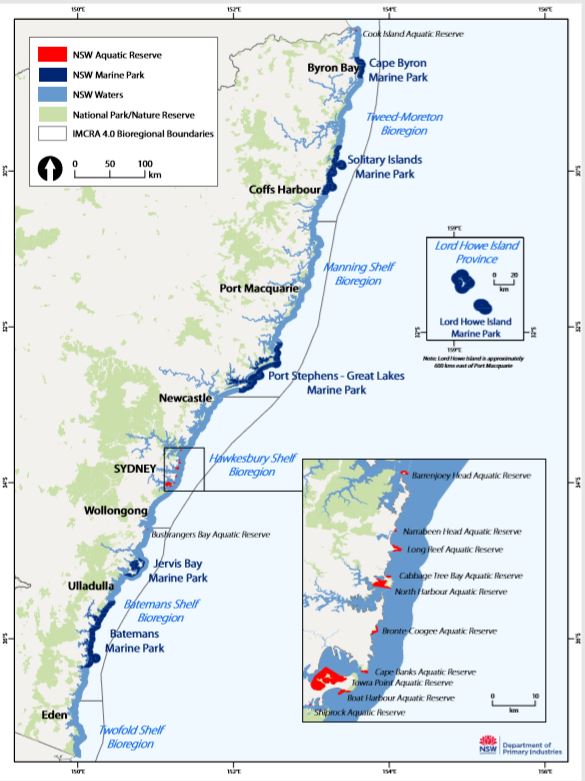

Batemans Marine Park
Established in 2007, the Batemans Marine Park features vast expanses of rocky reefs that support a diverse array of fish, invertebrates and seaweeds. The marine park stretches from the northern end of Murramarang Beach, near Bawley Point to the southern shore of Wallaga Lake at Murunna Point.
Situated on the far south coast, the marine park falls within the southern most range of the East Australian Current (EAC) and is bathed by both the sub-tropical waters of the EAC from the north, as well as cooler currents from the south. The result is a unique "mixing zone" where sub-tropical and temperate marine species can co-exist.
Protected species occurring in the marine park include sharks, fish, birds, whales and dolphins. The numerous islands within the park provide breeding areas for rare and threatened seabirds such as the sooty oystercatchers (below left) and little penguins. The endangered grey nurse shark is known to aggregate at sites at Tollgate and Montague Island, where they gather, feed and mate. The threatened great white shark also occurs in this area, and individuals are occasionally sighted. Both common and bottlenose dolphins are regularly seen throughout the marine park as well as Humpback, Southern Right and Killer whales.

Montague Island is also home to a large population of Australian Fur Seals, with New Zealand Fur Seals (above right) also visiting the island. Large aggregations of morwong, trevally and snapper are also found in abundance off Montague along with pelagic species like kingfish, albacore and yellowfin tuna following the warmer currents.
The park also contains highly significant coastal lakes and lagoons, including Durras, Brunderee, Tarourga and Brou Lake, many of which have been recommended for protection. These smaller lakes are intermittently closed and open to the sea which creates unique environments predominantly found along the south coast of NSW.
Larger rivers including the Clyde and Moruya also have significant estuarine habitats including mangrove, seagrass and saltmarsh. The Clyde River is one of the most pristine in NSW. This is primarily due to the majority of the land adjacent lying within National Park or State Forest. The clear blue waters of Wagonga Inlet (above) are caused by the white sands found throughout its entrance and its deep permanent opening to the sea. The inlet is unique as it has one of the healthiest populations of the seagrass Posidonia within NSW an important habitat to juvenile fish and invertebrates. The protected Black Cod have also been seen within the Inlet.
Batemans Marine Park Education Kit Downloads
Introduction 1.24 MB
Module 1: Marine Parks 2.28 MB
Stage 1 Video - titled 2 MB
Stage 1 Video - non-titled 2.07 MB
Stage 2 PowerPoint 2.09 MB
Stage 3 Zoning Guide 500 KB
Module 2: Rocky Shores 4.14 MB
Stage 1 PowerPoint 3.82 MB
Module 3: Estuaries 2.48 MB
Module 4: Sea Country 2.77 MB
Contact
Please contact us to request a copy of the education kit on CD-Rom or for further information about taking your students on a marine parks school excursion. The CD-Rom includes resources for all six marine parks.
Feedback form
More information about Batemans Marine Park
-
Quicklinks
- About us
- Consultation
- Research & monitoring
- News & publications
-
New Publication

Recreational fishing in
NSW marine parks
2.9 MB