
Solitary Islands Marine Park
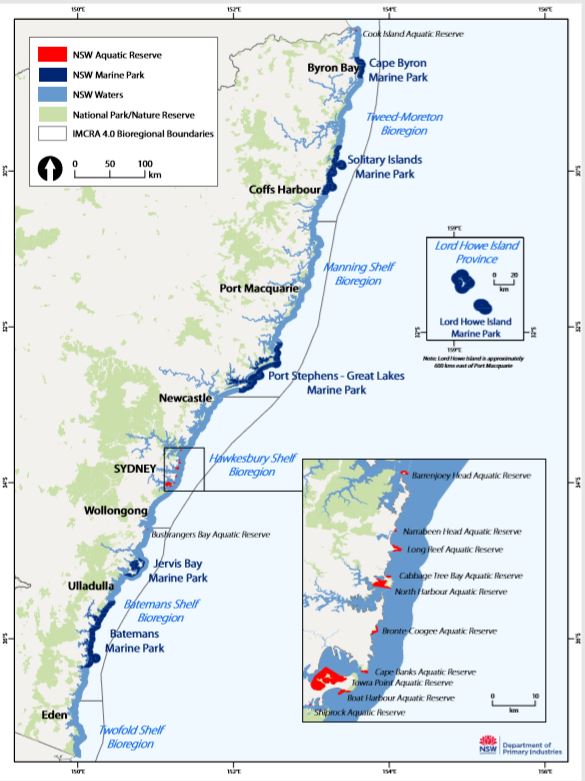
Established in 1991, the Solitary Islands Marine Park (formerly a marine reserve) is one of the oldest marine parks in NSW. The marine park stretches from Muttonbird Island in the south to Plover Island (at the Sandon River) in the north, and incorporates five “Solitary” islands, rock outcrops and reefs, and an array of beaches, rocky shores and estuaries.


Its location along the NSW coast ensures it is bathed by both the warm tropical
waters of the East Australian Current from the north, as well as cooler currents
from the south. The result is a unique “mixing zone” where tropical, sub-tropical
and temperate marine species can co-exist.
To date, over 550 species of reef fish have been observed throughout the marine park. This is diverse for New South Wales and is mainly due to the range, extent and complexity of reef habitat in the Solitary Islands area, combined with the mixed influence of the tropical and temperate currents. The extensive reef habitat is due in part to the offshore continuation of rock from the adjacent coastal range.
Estuaries within the marine park are reported as some of the most pristine in NSW; in particular, and largely because the majority of adjacent land is located in Yuraygir National Park, the Sandon River, Wooli Wooli River and Salt-water Creek arm of the Corindi River. In the Sandon and Wooli Wooli Rivers, it is possible to find all of the seven known species of mangroves that occur in NSW.
Protected species occurring in the marine park include sharks, fish, molluscs, corals, birds, sea-turtles, whales and dolphins. The endangered grey nurse shark is found throughout the marine park, but is known to aggregate at sites at North Solitary Island, South Solitary Island and Pimpernel Rock (in the Commonwealth Marine Reserve). The threatened great white shark also occurs in this area, and individuals are occasionally sighted.


Three species of sea-turtle: loggerhead, green and hawksbill, which are all threatened,
are also found in the marine park throughout the year, with resident turtles at
some sites. Both common and bottlenose dolphins are regularly seen throughout the
marine park, as well a number of whale species.
Solitary Islands Marine Park Education Kit Downloads
Introduction 1.25 MB
Module 1: Marine Parks
2.31 MB
Stage 1 Video - titled 2.09 MB
Stage 1 Video - non-titled 2.15 MB
Stage 2 PowerPoint 2.09 MB
Stage 3 Zoning Guide 1.45 MB
Module 2: Rocky Shores
3.98 MB
Stage 1 PowerPoint 3.82 MB
Module 3: Estuaries 2.54 MB
Module 4: Sea Country 2.68 MB
Additional Fact Sheets:
Fact Sheet – Local shipwrecks and other maritime heritage
141 KB
Caring for our marine environment
172 KB
History and management of the SIMP
151 KB
What is so special about the SIMP?
95 KB
Fishy facts
53 KB
Contact
Please contact us to request a copy of the education kit on CD-Rom or for further information about taking your students on a marine parks school excursion. The CD-Rom includes resources for all six marine parks.
Feedback form
More information about Solitary Islands Marine Park
-
Quicklinks
- About us
- Consultation
- Research & monitoring
- News & publications
-
New Publication

Recreational fishing in
NSW marine parks
2.9 MB